Why habb
The seed your grandmother already trusted.
Habba Barakah. The black seed. Kept on kitchen shelves across the Middle East and South Asia for fourteen hundred years — named in the Sunnah, pressed by every grandmother who ever fed a fevered child a teaspoon and waited.
We didn’t invent it. We just verified it. The ritual is older than the lab. The lab is overdue.
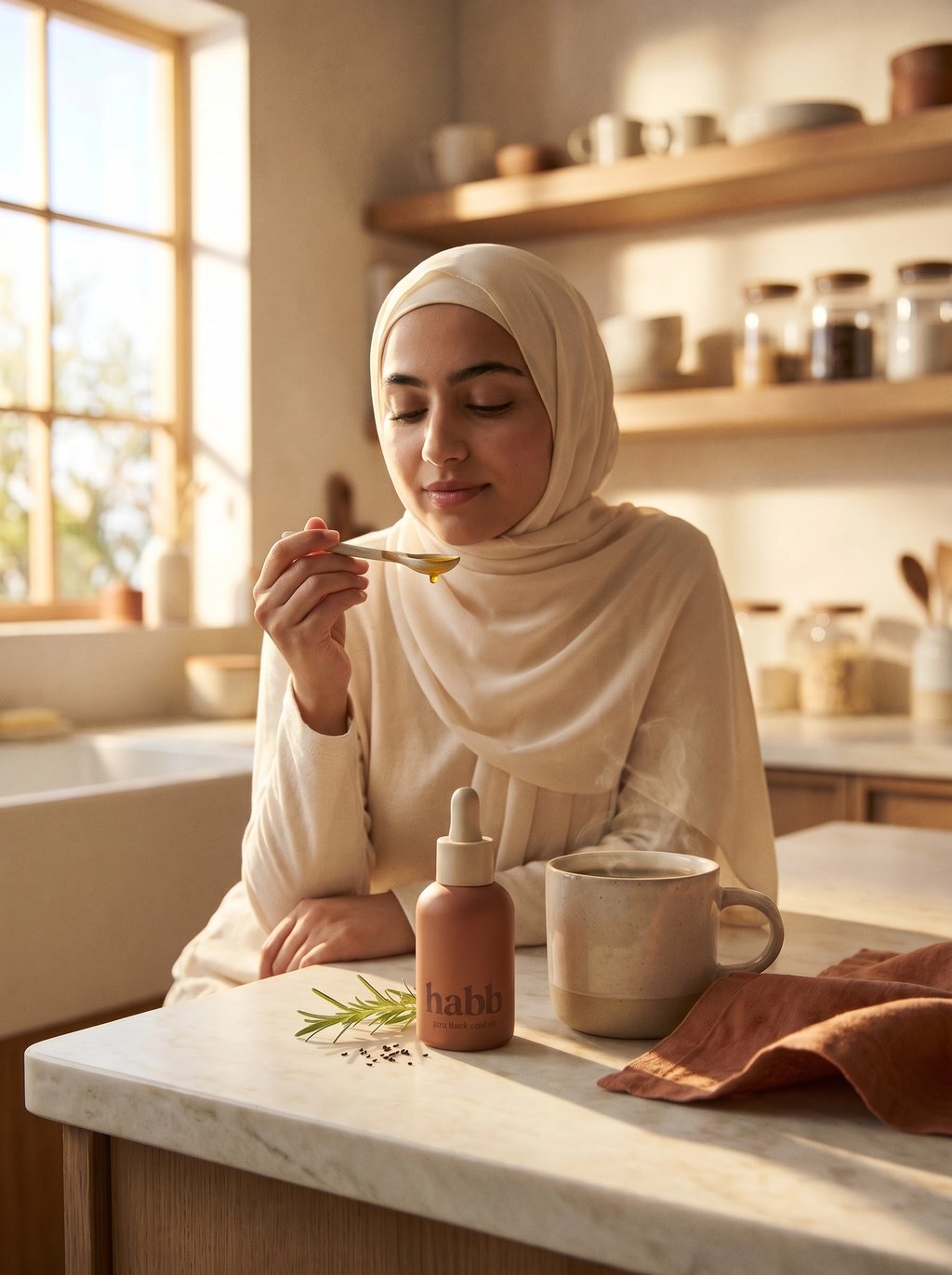
Habba Barakah
The seed your grandmother kept on the shelf.
Nigella sativa. The plant grows wild from the Levant through Iran and into the Indian subcontinent. The seeds are small, matte black, faintly bitter when chewed. Kitchens from Cairo to Karachi to Sana’a have kept a jar of them within arm’s reach for as long as anyone in those kitchens can remember — sprinkled on bread, cold-pressed for a teaspoon in the morning, brewed with honey when someone was sick.
In the Islamic tradition the seed is called Habba Barakah — the seed of blessing. It’s a daily kitchen-shelf practice with deep roots, which is one reason a billion-plus people grew up with the seed already in the house.
The continuity is the unusual part. Olive oil moved from kitchen staple to wellness cabinet about a decade ago; cold-pressed black seed never left either shelf in the regions that grew up with it. What changed is who’s asking for it. The seed didn’t change. The ask did.
What we added is verification. Habba Barakah is what our grandmothers had. The lab card is what they didn’t need — because the seed jar in their kitchen was identifiable on sight. The seed jar in your kitchen isn’t. So we publish the numbers. See the lab card →
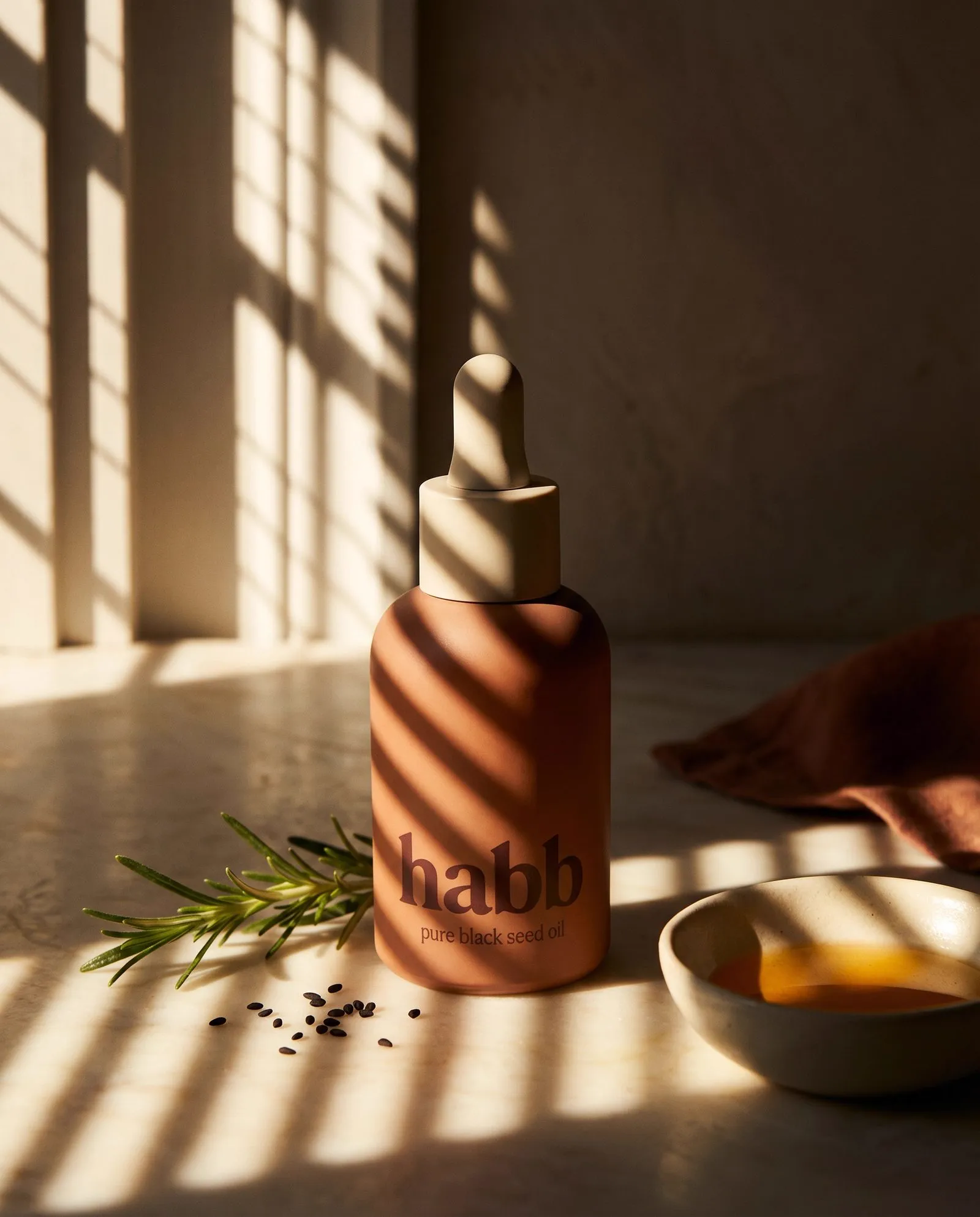 habb
habb
Inside
Diluted.
One ingredient.
Often cut with soybean or canola. Sometimes stabilized with TBHQ. Sometimes carrying hexane residue from extraction. You pay seed-oil prices for filler. We bottle one ingredient. See the source →
Lab tested
Untested.
Every batch.
Most bottles ship without a third-party lab number on the label. We test every batch with an independent lab and publish the result on the card in the box. See the lab card →
Origin
“Premium.”
Ethiopia.
Most black seed oil is bulk Egyptian or Turkish, harvested at industrial scale. Ethiopian costs several times more — volcanic soil, altitude, smaller harvests, measurably stronger oil. We pay it. See the origin →
Pressed
Unspecified.
Under 60°C.
Heat changes the oil. We hold the press below 60°C and publish the temperature on every batch card. See how it’s pressed →
Bottle
Plastic.
Glass.
Oil sits on shelves for months. Plastic sheds the whole time, faster in heat. Glass doesn’t shed and doesn’t react with the oil. We chose glass.
Certified
Unverified.
Halal · Kosher.
An independent inspector walks the facility — Halal-certified, OU Kosher, FDA-registered. Self-claimed logos skip the audit. Ours is verified by people who showed up.
Fourteen hundred years on the kitchen shelf. Three years on the lab bench. The seed didn’t change. The proof is finally in the box. Our lab numbers ship with every bottle.
Hold my bottle